It was a Sunday. Neetan did not have to take leave from office. The strange thing was that, despite all the turmoil around him, he had not the faintest idea of what was happening in his own life. Whenever such episodes occurred, it seemed as if he were cut off from the flow of life—as if he had slipped into a strange slumber. And when he woke up, he remembered nothing of what had transpired during that period.
By now, even Ruchika had begun to believe that Neetan might be suffering from a split personality. After speaking to Doctor Ram Prasad, she had spent long hours browsing the Internet. This gave her a clearer understanding of how such conditions could affect a person’s behaviour. She began to suspect that there was something in Shubhangi that switched off one of Neetan’s personalities and activated another.
As she got ready to take Neetan to Doctor Ram Prasad’s Treatment Centre, her heart was filled with both hope and anxiety. She feared that seeing Shubhangi on screen might trigger a violent reaction in Neetan. Yet, she also felt reassured that these efforts might finally lead to a solution.
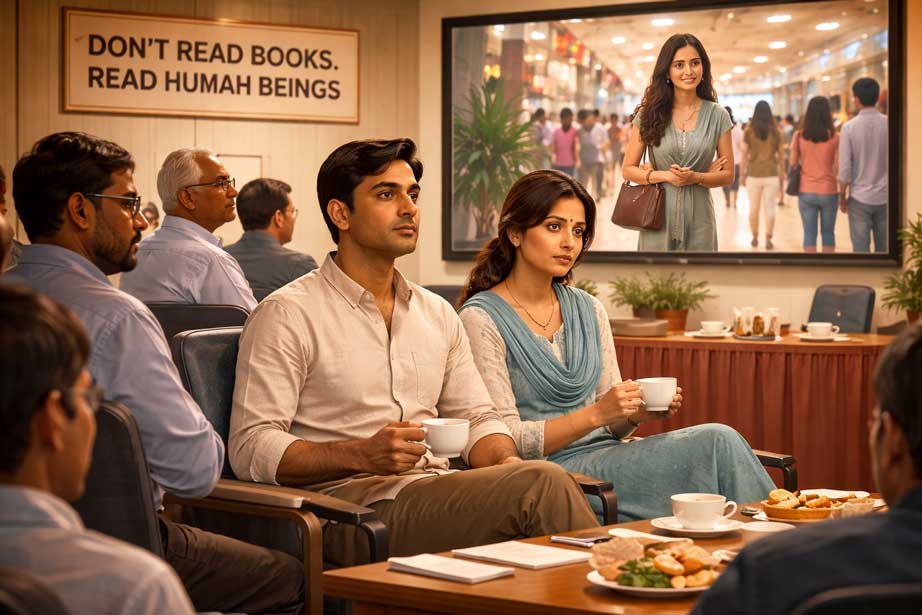
When they arrived at the Centre, Doctor Ram Prasad and his students were seated in the conference hall. The atmosphere was light—full of laughter, casual conversation, and friendly banter. On a large screen mounted on the wall, an English movie was playing.
Doctor Ram Prasad firmly believed that understanding human beings required observation and interaction, not rote learning. A prominent board in the hall boldly declared:
DON’T READ BOOKS. READ HUMAN BEINGS
Neetan was seated in such a way that his gaze naturally fell on the television screen. As the informal chatter continued, one of the students discreetly switched off the movie and replaced it with the video clips that Ruchika had provided the previous evening.
Tea and snacks were served. The environment felt more like a picnic than a clinical experiment.
Then, suddenly, Shubhangi appeared on the screen.
Doctor Ram Prasad, Ruchika, and the students braced themselves for a reaction—any sign of disturbance, agitation, or transformation.
But nothing happened.
Time passed. Tea was followed by lunch, and lunch by another round of tea. Shubhangi appeared multiple times in the footage, yet Neetan remained completely unaffected. He sat quietly, almost indifferently, as though she held no significance in his world.
Finally, it was time to record observations. Neetan and Ruchika were each given pen and paper and asked to note down what they had experienced.
Doctor Ram Prasad examined Neetan’s writing with great care, searching for any trace of abnormality. But he found none.
After a while, he called Ruchika aside.
“We will have to extend this test,” he said. “It needs to be more elaborate. Let us take a break for a few days. In the meantime, try to procure a video in which Neetan is actually seen causing a disturbance. We need to observe how he reacts to himself in that state.”
He paused, then added, “If that does not work, we may have to take him to the shopping mall when that girl is present. We will coordinate with the mall management.”
Ruchika looked worried. “But Doctor, he loses control when he sees her.”
“Don’t worry,” the doctor replied calmly. “I will carry the necessary medication. We will be prepared.”
Ruchika and Neetan returned home.
Back at the Centre, Doctor Ram Prasad continued discussing the case with his students for some time. Gradually, they all left—except Kritika.
She lingered, speaking casually at first. Then, after a pause, she said:
“Doctor, may I say something?”
“Yes, Kritika?”
“Could it be that Neetan is reacting—not to Shubhangi’s body—but to her soul?”
The doctor let out a brief laugh.
“Kritika, I am a doctor of minds, not of souls.”
Kritika remained composed. “Yes, Doctor. But my uncle… he works in that area. If you permit, I would like to take Ruchika and Neetan to him.”
The doctor’s expression hardened slightly.
“I do not believe in such notions,” he said. “And in any case, the decision is theirs. If they come to me, I will treat them using methods I understand. If they choose otherwise, that is entirely up to them.”
He rose abruptly.
“I have some urgent work now. Good night, Kritika.”
Kritika understood that he had not appreciated her suggestion. But her concern was not to please him—it was to help Neetan.
As the doctor was leaving, he paused, turned back, and asked, almost casually:
“Which ashram does your uncle run?”
Kritika replied, “For thirty years, he was a professor of Physics at a university in California. Then he returned to India. He spent years with saints and tantriks, even lived in Himalayan caves. He has studied our scriptures deeply, along with Western psychology.”
The doctor said nothing more and walked away.
Soon after, Kritika stepped out of the Centre and called Ruchika.
“Madam, I would like to meet you. If it is convenient, I can come to your house. Otherwise, we could meet at a nearby café.”
Within half an hour, the two were seated in a Starbucks, sipping coffee.
Kritika spoke at length about her uncle. Ruchika listened, though she remained hesitant.
“We have already started treatment with Doctor Ram Prasad,” she said. “Let us continue for a few days. If it does not work, I will consider meeting your uncle.”
Kritika persisted, sharing incidents and experiences that gradually convinced Ruchika to remain open to the idea. In this difficult time, Ruchika felt a quiet gratitude—so many people were stepping forward to help her.
Instead of returning home, Kritika went directly to meet her uncle. She told him everything.
Later, she called Ruchika.
“Didi, my uncle is leaving for a foreign trip the day after tomorrow. He will return in about twenty days. He says that once we begin, we should not have to stop midway—so we should start only when enough time is available.”
She continued, “Meanwhile, he has given me a small idol of Bhagwan Hanuman ji. It has been worshipped in his temple for many years. He says that if you hold it in your hand and chant ‘Om,’ it will help bring clarity and solutions.”
“May I come tomorrow and give it to you?”
The next day, Ruchika received the idol with deep faith. She placed it in the small temple she maintained in a corner of her home.
Every morning and evening, she sat quietly, holding the idol, chanting ‘Om.’
Gradually, her mind began to become calm.
A quiet realization dawned upon her—that whatever was unfolding was part of a much larger design, a vast and intricate system before which she could only surrender.
Send your comment / query